F—01
Technical strategy
Sets the long-view direction and the standard every engagement is measured against — including which work the studio declines.
Founder & CEO
Sets the vision and the standard the whole studio builds to.
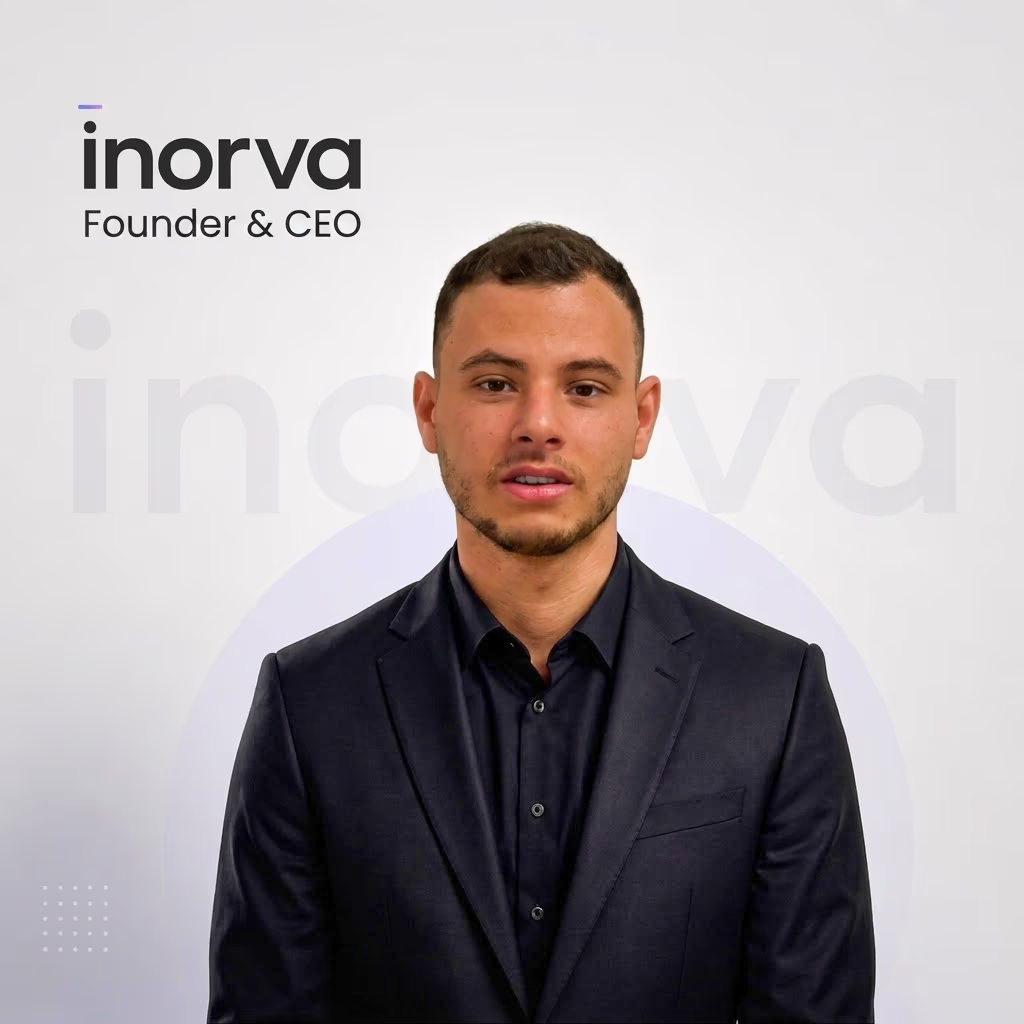
Youssef Fattouh is the founder and Chief Executive Officer of Inorva, a Cairo-based AI and software studio he started in 2025 after three years leading engineering as a chief technology officer.
He read computer science and artificial intelligence at Benha University's Faculty of Computers and Artificial Intelligence, one of the few Egyptian faculties to teach the two as a single discipline rather than a specialism bolted onto a computing degree. That framing — AI as part of how software is built, not a layer applied afterwards — is more or less the thesis Inorva was founded on.
Before Inorva, he spent three years as chief technology officer at a private software company, where most of what he built never faced a customer. It was internal: the systems a business actually runs on — operations tooling, data flow between departments, the processes that quietly decide whether a company can grow without hiring proportionally. Building for colleagues rather than a market is an unforgiving school. There is no marketing to compensate for a tool people hate using, and you watch every shortcut you took get paid for in support requests.
That period shaped the conviction he founded the studio on. He had seen how much of a company's real advantage lives in its own data and its own workflows, and how little of that advantage survives being handed to a templated platform. The distinction he draws is between using AI and owning it: renting intelligence from a vendor gets you the same capability your competitors are renting, on terms someone else sets, and it expires the moment the subscription does. A system built around your data belongs to you and compounds.
At Inorva he sets technical direction and owns delivery — deciding which engagements the studio takes, how they are scoped, and what standard they are measured against before anything ships. He works most closely with clients at the front of a project, where the question is still what should be built rather than how, and he is the one who will tell a prospective client that the studio is the wrong fit for what they are asking for.
He works in Arabic and English, and the studio's bilingual practice is deliberate rather than a service line: Inorva builds for clients in Egypt, across the Gulf, and internationally, and treats Arabic as a first-class engineering constraint — right-to-left layout, Arabic-native content models, and AI agents that answer in the language the customer wrote in.
Where each of them goes deep — the disciplines they own day to day.
Sets the long-view direction and the standard every engagement is measured against — including which work the studio declines.
Champions systems companies own outright, shaped around their own data and processes rather than rented from a template.
Multi-step agents that take real actions across a company's tools — the studio's highest-value and most defensible work.
Turns strategy into shipped product on a cadence clients can plan around, with scope decided before the first commit.
Operations tooling and workflow automation — the unglamorous infrastructure that decides whether a business scales cleanly.
The tools these systems are actually built with — products in production use, not a list of everything the studio has ever touched.
Founded the studio to build AI and software systems that clients own outright. Sets technical direction, scopes engagements, and owns delivery across all three units.
Led engineering and technical strategy. Built the internal systems the business ran on — operations tooling, cross-department data flow, and the automation underneath both. Company name withheld.
Studied computing and artificial intelligence as a single discipline — the framing the studio's engineering practice still follows.
Youssef Fattouh is the founder and CEO of Inorva, an AI and software studio based in Cairo and working with clients across Egypt, the Gulf, and internationally. He founded the studio in 2025 after three years as a chief technology officer, and holds a bachelor's degree in computer science and artificial intelligence from Benha University.
Start a conversation and we'll route you to whoever is closest to what you're building.
Get in touch